
Cantinetta: The Twelve-Hour Flame
-
Rating Value:4.7
-
Price Range:€€
-
Explore Online:
-
Country:Croatia
-
City:Skradin
-
Phone:
-
Address:Aleja skradinskih svilara 7, 22222, Skradin, Croatia
The Thesis Hook
Skradin demands neither devotional reverence nor modern theatrics; it commands unyielding patience. In an era governed by rapid extraction and shallow plating, Cantinetta Restoran operates as an austere citadel of nineteenth-century culinary preservation. Here, the dialogue between sharp Adriatic salinity and the meditative, slow-burn mechanics of the Dalmatian hinterland is treated not as a quaint folk tradition, but as an uncompromising structural discipline. This is dining stripped of contemporary artifice, grounded entirely in mechanical labor, thermodynamic tension, and historical continuity.
Context & Geography
Perched at the liminal intersection where the brackish waters of the Krka estuary meet historical Venetian trading corridors, Skradin has long functioned as a cultural and culinary transit hub. Cantinetta does not exist to flatter tourists traversing the coast; it anchors the town's living memory. Chef Tome Računica approaches the kitchen not as an auteur inventing novel forms, but as an archivist maintaining exacting custodial control over communal technique. In the narrow limestone corridors outside the dining room, the atmosphere is heavy with the aromatic output of long-simmering veal stock and alliums breaking down over steady heat. The kitchen's existence is an architectural dialogue with local history—a refusal to sever ties with the labor-intensive heritage of Dalmatia.
Atmosphere & Choreography
The physical mechanics of the dining room unfold upon a breezy veranda framed by precisely spaced tables cloaked in crisp linen. The acoustic profile is hushed and contemplative, punctuated only by the deliberate, muted murmur of seasoned travelers and the precise scrape of silver spoons against dense ceramic. Service operates with whispered efficiency rather than stifling formality; the front-of-house staff navigate the room with understated precision, anticipating table intervals without hovering. The environment calms the nervous system, establishing an unhurried tempo that prepares the diner for the deliberate, slow-paced culinary narrative ahead.
The Meal (The Progression)
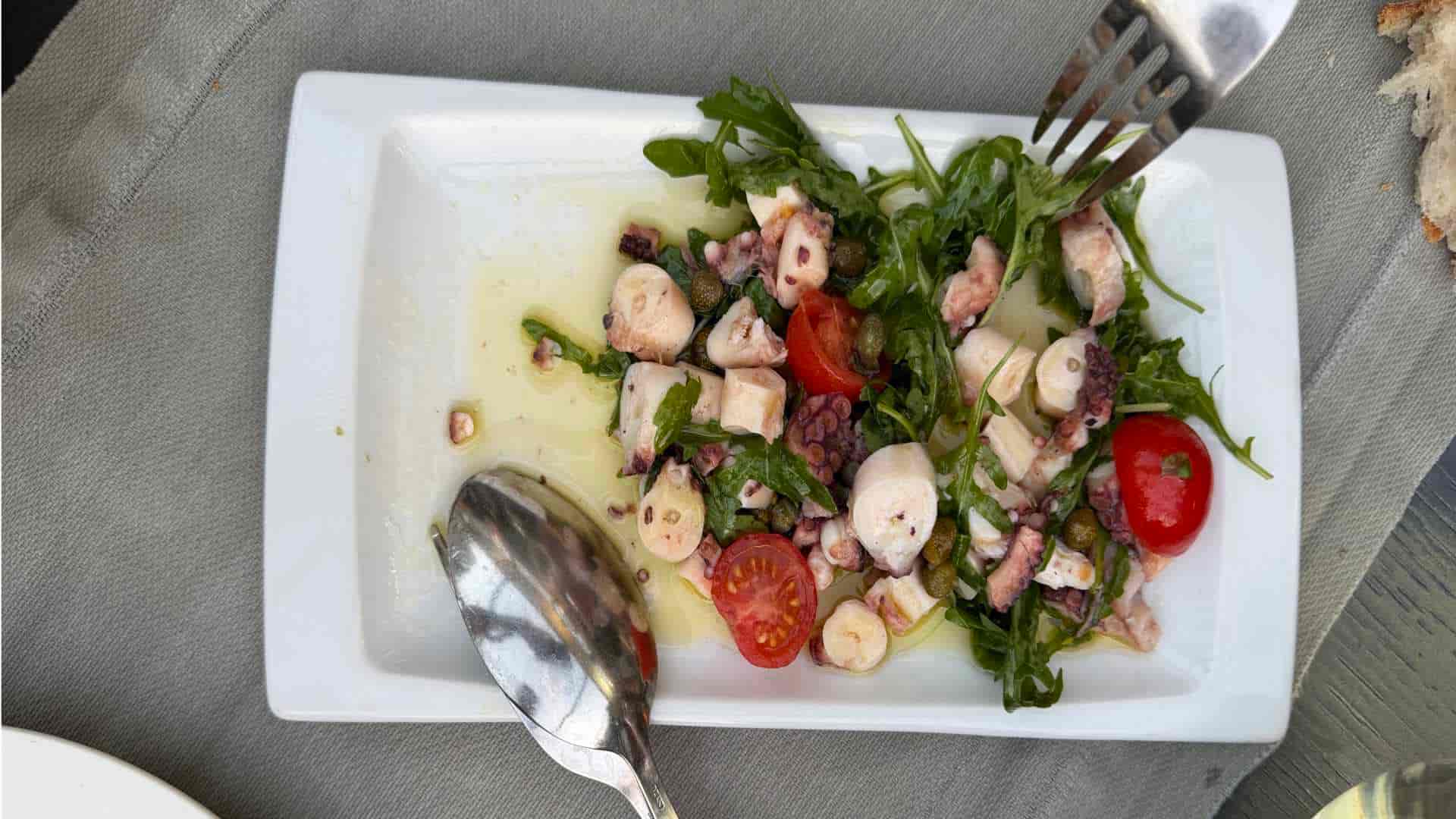
The Gateway: The meal opens with an exercise in pristine coastal restraint: tender octopus, sliced with disciplined geometric clarity and presented alongside ripe, taut cherry tomatoes, pungent capers, and wild peppery arugula bathed in cold-pressed local olive oil. The octopus retains an elastic, clean marine bite, entirely devoid of rubbery resistance or over-tenderized mushiness. The dressing provides a sharp, balanced acidity that cuts cleanly across the palate, setting an intentional baseline of freshness before the rich, collagen-heavy courses follow.
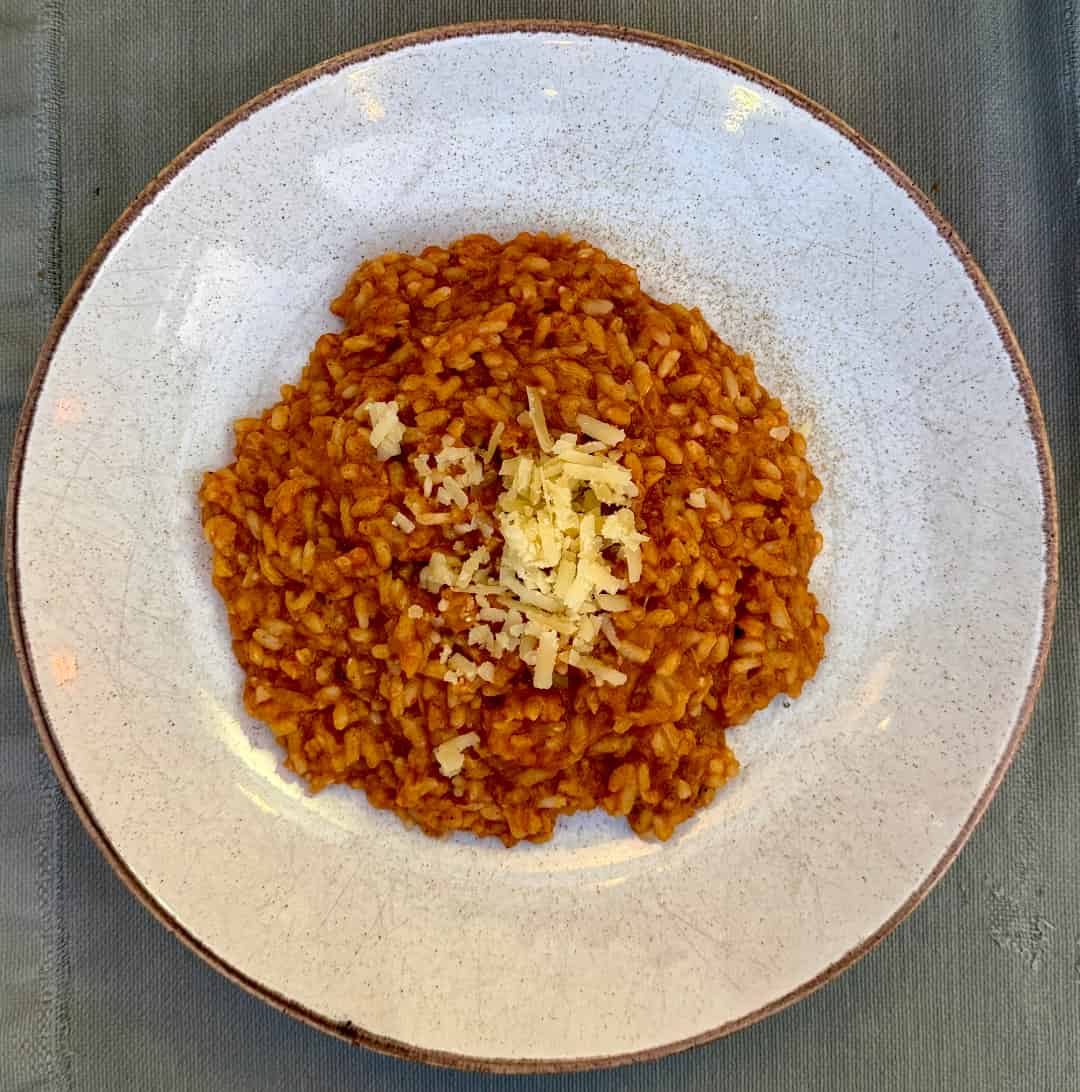
The Apex: The undeniable focal point of the menu is the canonical Skradinski Rižot—a historic nineteenth-century preparation requiring twelve hours of continuous manual agitation over open flame using a heavy wooden paddle (veslo). Under this unrelenting thermal and mechanical stress, dense veal topside, rich bouillon, and caramelized red onions completely disintegrate, yielding a glossy, deeply unctuous emulsion that coats every grain of rice without a drop of superfluous cream. Served as a warm, amber dome, each mouthful delivers profound savory depth, sharply accented by the woodsy warmth of freshly grated nutmeg and the crystalline, savory punch of aged local sheep's milk cheese. It is a tour de force of physical endurance and collagen extraction.
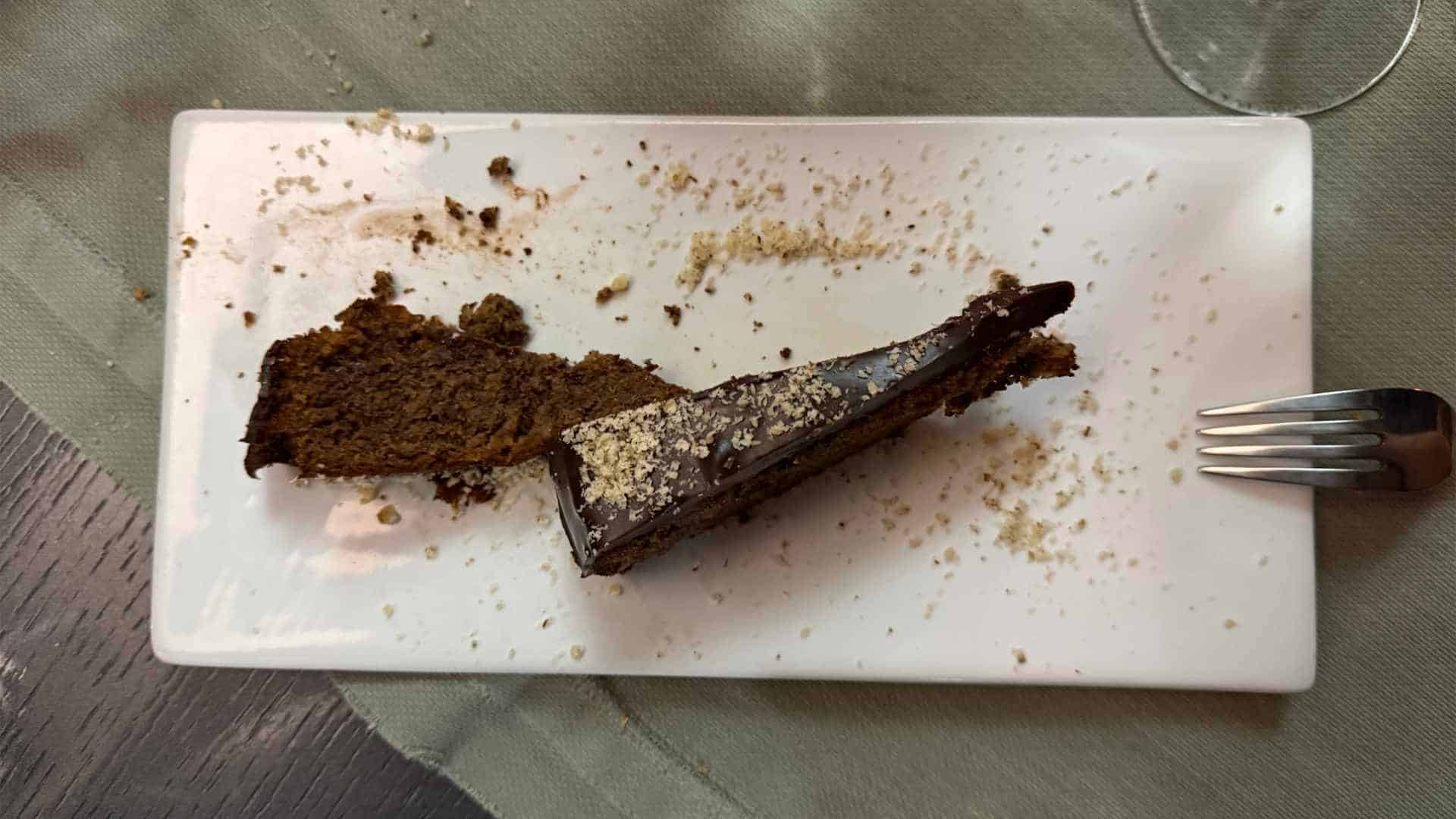
The Flaw: The only discernible fracture in pacing arrives immediately following the risotto. A palate cleanser of chilled raw watermelon, while functionally effective at clearing residual animal fats, feels conceptually underworked and abrupt. It lacks the structural nuance found across the rest of the menu, serving as an overly plain interlude before the arrival of the formidable fourteenth-century Skradinska torta. Fortunately, the flourless cake quickly redeems the finale with its dense matrix of ground walnuts, almonds, and local honey encased in a shell of bittersweet dark chocolate.
The Beverage Narrative
Cantinetta’s beverage narrative is woven directly into the structural chemistry of its dishes. The fourteenth-century Skradinska torta relies on rozulin—an ancestral, small-batch rose liqueur macerated in the hinterland—not simply as a pairing alongside the plate, but as an essential botanical ingredient inside the crumb. Its delicate floral ethanol cleanly pierces the heavy lipid profile of the walnuts and honey, transforming what could be an overwhelming confection into an aromatic, historically resonant tribute to old Venetian trade routes.
Calibration (Service & Value)
Cantinetta monetizes an asset that modern commercial kitchens actively avoid: twelve uninterrupted hours of human labor devoted to a single copper pot. The value proposition here is not rooted in imported luxury commodities, but in the rare preservation of artisanal stamina and cultural heritage. Delivered with attentive, dignified hospitality in an intimate setting, dining here represents an exceptional transaction between financial cost and authentic historical value.
Weighted Analytical Scorecard
- Food & Cuisine (Max 10): 9.0 / 10 — Benchmark structural execution of the Skradinski Rižot; minor linear simplicity in the pre-dessert transition.
- Service & Choreography (Max 5): 4.5 / 5 — Seamless pacing, discreet room presence, and disciplined table maintenance.
- Wine & Beverage Program (Max 5): 4.0 / 5 — Masterful integration of indigenous botanical elixirs (rozulin) within the menu's culinary architecture.
- Experior Travel Composite Score: 17.5 / 20 — An authoritative monument to historical Dalmatian technique.