
The Alchemy of Albacore: Demanding Culinary Animism on the Shores of Huahine
-
Coordinates:16.7333° S, 151.4500° W
-
Estimated Budget:€€
-
Trip Type & Duration:Culinary Field Exploration / Gastronomic Experience; Half-Day (1 Day)
-
Related Destinations:Huahine, Society Archipelago, French Polynesia, Bora Bora
Anatomy of a Flash-Cure: How Acid, Lipid, and Pelagic Muscle Collide in the Society Islands
The Pacific does not gently lap the iron-bound shores of Huahine; it assaults them, throwing up a fine, salt-rimed mist that hangs heavy over the volcanic black basalt. Under the grey light of a damp dawn, the humidity registers at ninety percent, plastering canvas shirts to skin. On the salt-scoured timber of a crude prep table, a single, wild-caught albacore tuna lies gleaming, its cobalt-blue flank still radiating the deep-ocean cold of the pelagic trenches. There is no performance here, no tourist-brochure theater. Only the sharp, clean bite of a carbon steel blade slicing through muscle, and the heavy thud of a split coconut shell echoing against the surf.
Geography & The Stakes
Huahine-Nui and Huahine-Iti, cleaved by a narrow blue channel and ringed by barrier reefs, demand a severe kind of self-reliance. This is not the sterilized resort landscape of Bora Bora; it is a topography of steep, jungle-choked volcanic ridges and unforgiving currents. For centuries, survival on this isolated fragment of French Polynesia has rested on a knife-edge of maritime competence. To harvest the deep-water pelagic tuna (Thunnus alalunga) from the offshore drops requires battling swells that roll uninterrupted from the Southern Ocean. The culinary tradition born of this isolation is not an aesthetic luxury, but a high-stakes calculation of preservation and raw energy. Every ingredient—from the lime growing wild in the humid ravines to the mature coconuts clinging to saline-blasted palms—is hard-won, shaped by the harsh mechanics of equatorial geography and the violent chemistry of the sea.
The Logistics & The Movement
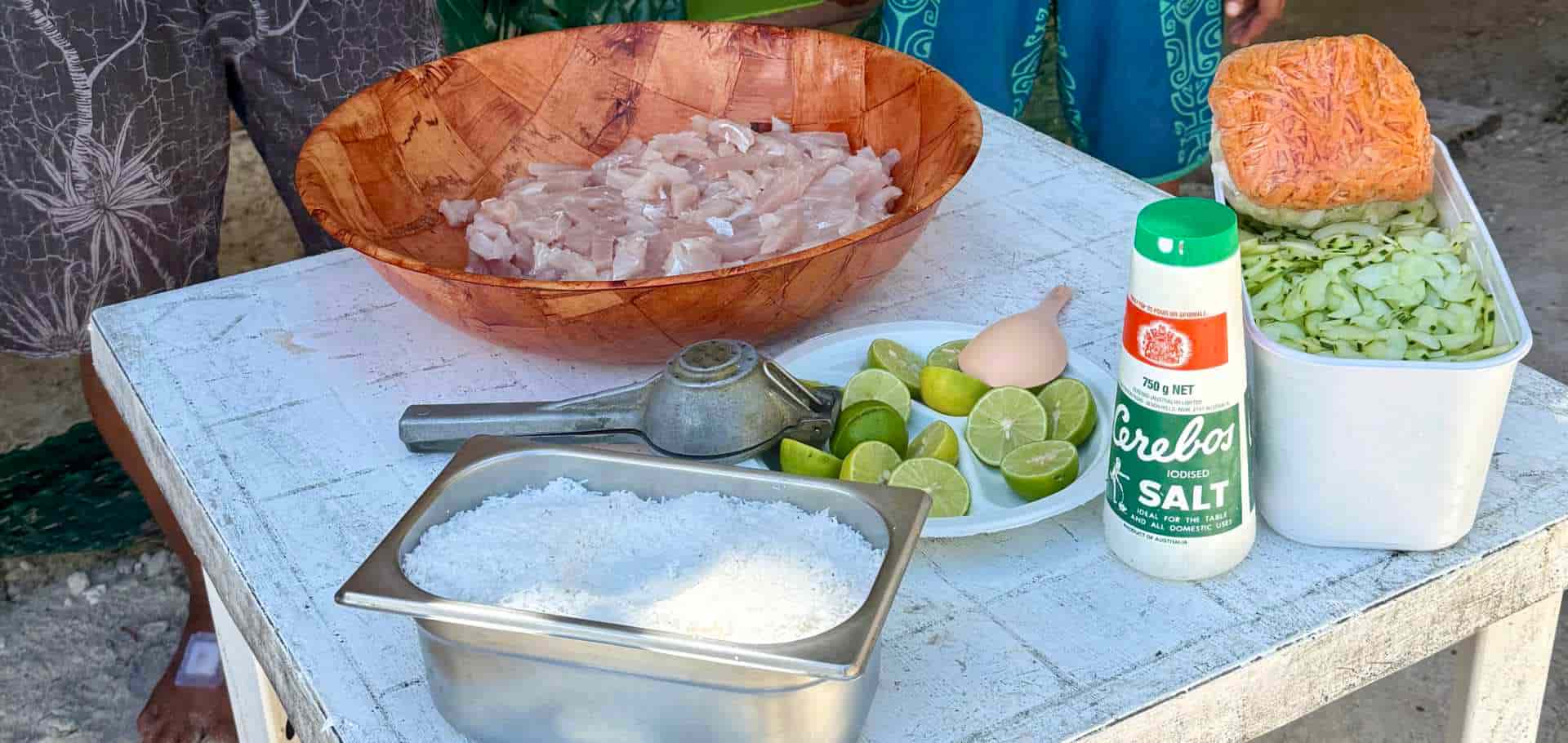
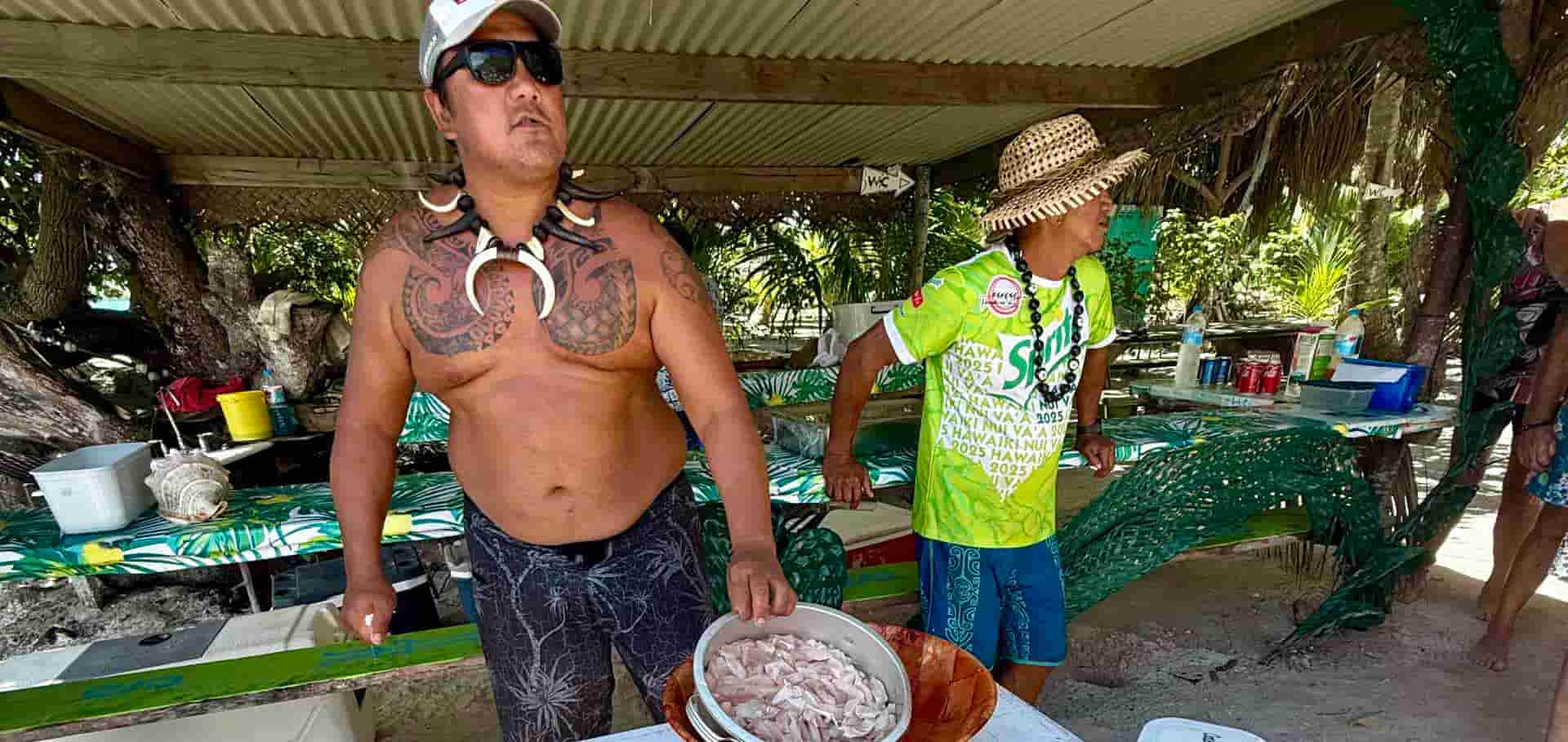
To witness the construction of 'Ota 'Ika here is to observe a masterclass in chemical kinetic control. The process rejects the slow, acid-cooked maceration of South American ceviches. It demands an immediate, violent collision of elements. The chef begins with the albacore tuna, carving the pale-rose, translucent flesh into precise, uniform two-centimeter cubes. These are subjected to a fleeting flash-cure: a hand-squeezed measure of local green lime (citron vert) and coarse sea salt. The contact is brief, measured in seconds, allowing the citric acid to tighten the protein's outer membrane while leaving the interior completely raw, cold, and biologically intact.
Next comes the extraction of the mitihari. This is a process of sheer physical leverage. The chef selects mature, heavy brown coconuts (haari) whose internal water has consolidated into dense, fat-saturated meat. With a rusted iron blade, the shells are split with mechanical precision. The white flesh is grated down to a moist pulp using a hand-fashioned iron rasp. Gathering the shredded fiber into calloused palms, the chef exerts immense grip force, wringing out the dense, opaque first-press milk directly over the acid-stung fish.
This is the critical tactical pivot: the high-fat coconut emulsion acts as an instant chemical brake. The dense lipids coat the tuna cubes, neutralizing the citric acid and arresting the denaturation process before the flesh turns chalky. The result is a perfect suspension. The salt, the fat of the coconut, and the sharp acidity of the lime do not layer; they fuse into a cohesive, velvety glaze that clings to the fish. The timing is non-negotiable. A delay of two minutes produces a flaccid, over-acidified product; too swift a preparation leaves the oil and acid separated, a failure of emulsion that insults the pristine quality of the pelagic catch.
The Human & Cultural Echo
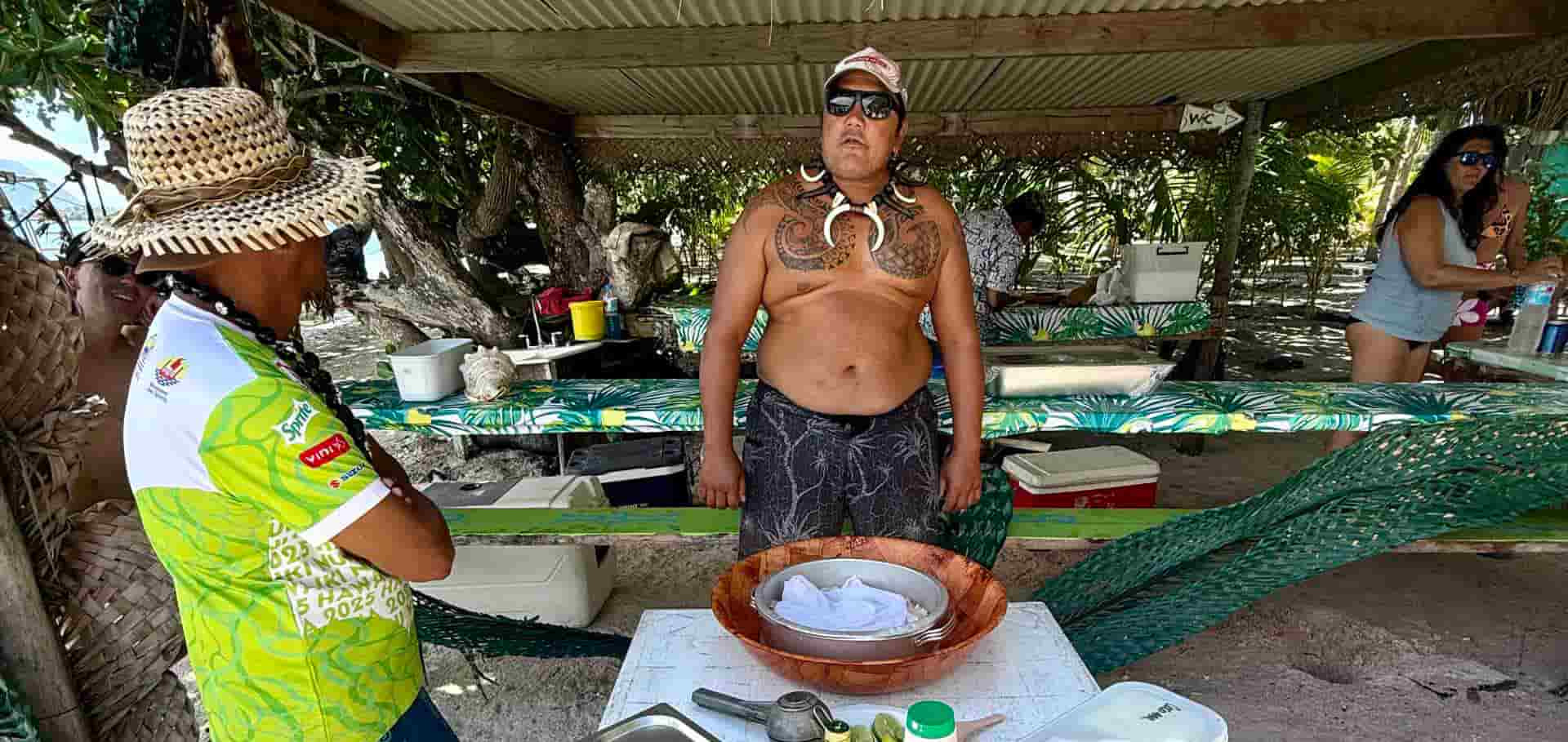
In the hands of the Huahine locals, this preparation is a form of culinary animism. The chef, whose skin is mapped with the indigo geometry of traditional tatau, does not speak of recipes but of respect for the tuna’s life-force. In Polynesian cosmology, the ocean is not a resource to be stripped, but a living ancestor, Moana. To over-process, cook, or disguise the natural texture of the albacore with extraneous imports would be an act of cultural amnesia. This minimalist technique is a direct transmission of ancestral survival tactics, dating back to the long-distance voyaging canoes that populated these islands. The preservation of the fish is temporary, designed for immediate consumption in a climate that rots flesh within hours. By consuming the raw muscle of the ocean alongside the life-giving fat of the coconut palm, the islander closes a sacred circuit, absorbing the raw kinetic energy of the sea through a ritual of absolute culinary utility and deep geographical reverence.
The Calibration & The Horizon
The effort-to-reward ratio of 'Ota 'Ika cannot be measured by the standards of modern leisure. It demands the physical labor of the deep-sea haul, the manual strain of the coconut press, and the mental discipline of split-second timing. What this plate offers is a sensory recalibration. It strips away the over-salted, highly preserved redundancies of continental gastronomy, forcing the diner to confront the raw, unadorned truth of the Pacific. It tests our capacity to appreciate simplicity, challenging us to find complexity not in elaborate technique, but in the precise, fleeting intersection of ocean, land, and human will.